My work spans LLM post-training, inference systems, and on-device products. The recurring question is:
when an intelligent model must perceive state, decide, and affect an interface or physical system within
tens of milliseconds, how should the model, action space, and execution stack be designed together?
Selected projects
Research, systems, and product
ICML 2026 · First author
SimpleTool / RealtimeTool
Parallel Decoding for Real-Time LLM Function Calling
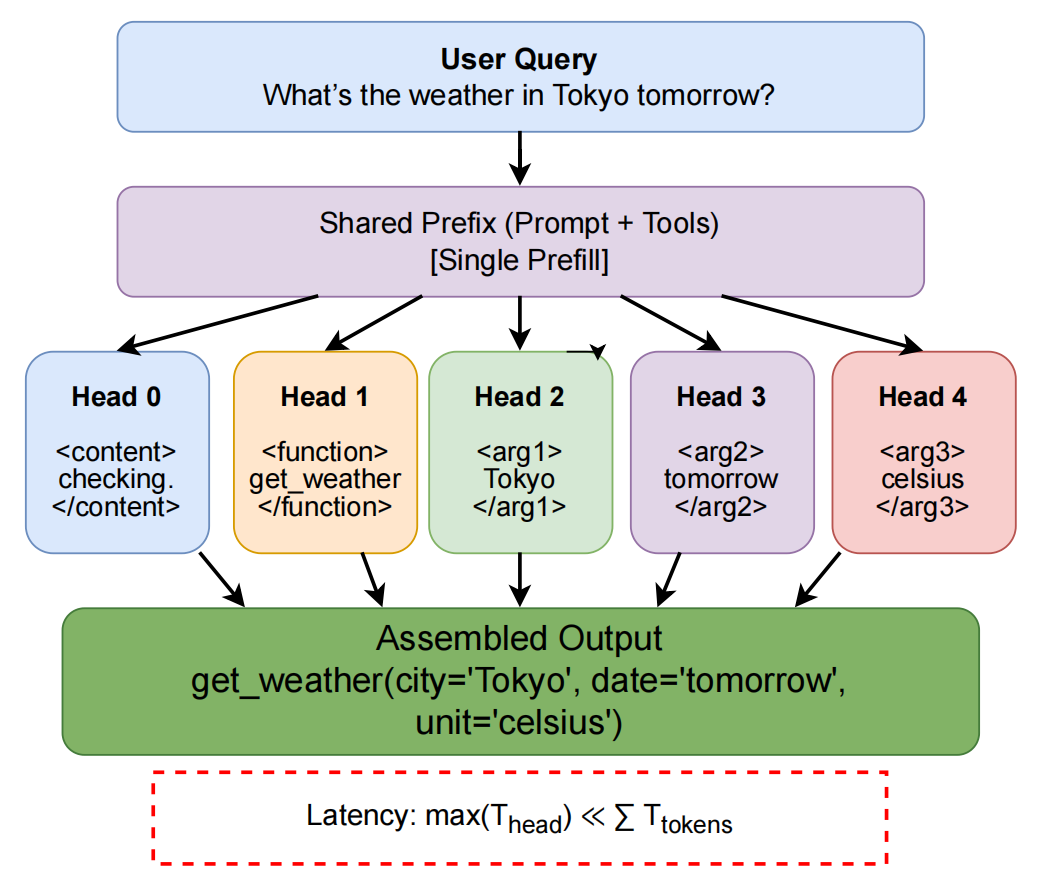
After one shared prefill, function names and arguments are generated concurrently across parallel heads,
removing the serial structured-decision bottleneck in real-time agents. It delivers 3–6× typical
end-to-end speedup and up to 9.6×, with RT-Qwen3-4B reaching 61.2 ms P50 on an RTX 4090.
Shared prefix / KV with parallel decoding of function and arguments.
Ongoing research · Embodied Agent-as-Policy
SimpleToolVLA
Typed tool calls as a scalable embodied action space
SimpleToolVLA treats tool calling as the high-level interface between an LLM / VLM and controllers,
VLA skills, or world-action models. Dynamic schemas define typed, composable, and verifiable semantic actions.
The current work tests two falsifiable hypotheses: whether simulation and synthetic tool trajectories scale
transferable policies, and whether the resulting edge loop can reliably meet physical deadlines.
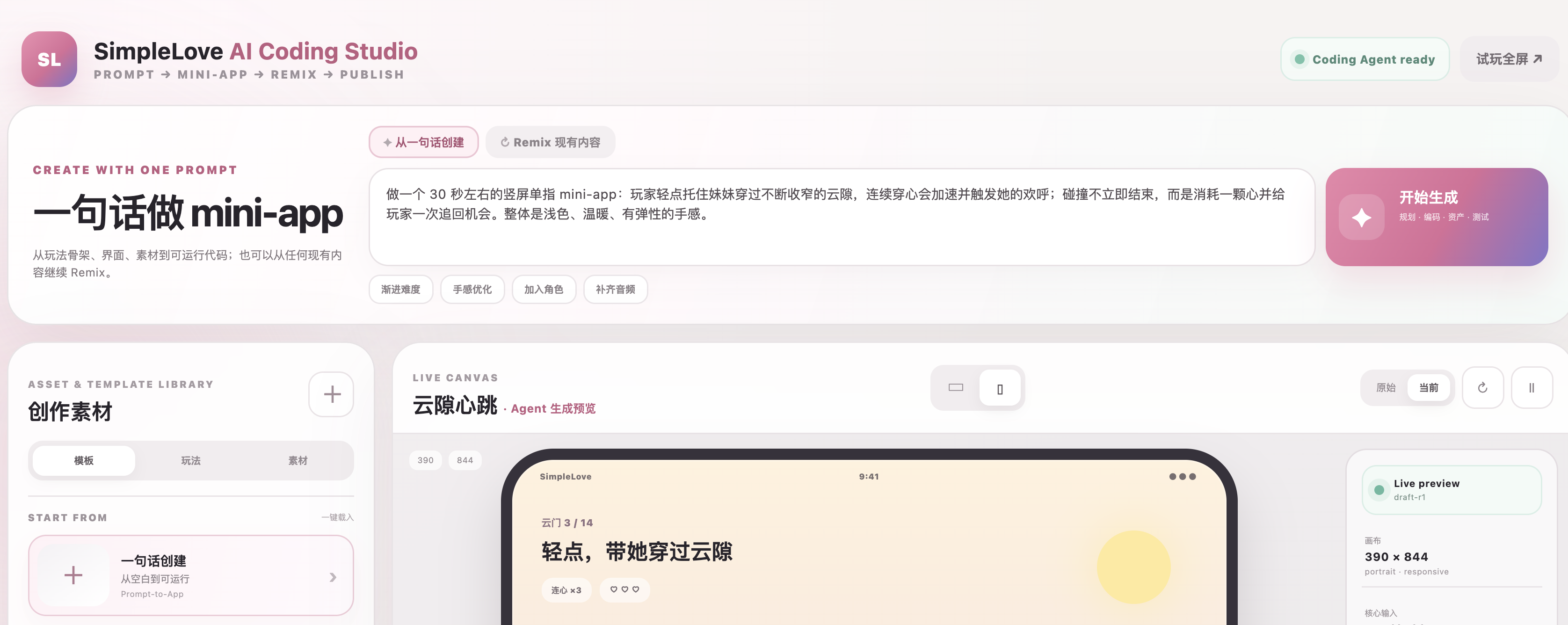
SimpleLove explores persistent AI-OC identity, cross-experience memory, and prompt-to-interactive-content.
One side is a content experience shaped by an OC, memory, and preference; the other is a creation platform
where agents help modify, test, and remix runnable experiences. The long-term goal is for the same OC to
grow from a character inside content into a personal agent on the user's devices.
In short: a “TikTok” for OC mini-apps, driven by coding agents and AIGC.
Prompt-to-content, AI remix, and runnable interactive experiences.
Experience & education
miHoYoIntern
Shanghai Innovation Institute / Shanghai Jiao Tong UniversityPh.D. student · post-training and infra · Advisor: Prof. Zengfeng Huang
Shanghai Jiao Tong UniversityB.S. in Chemistry · Computational chemistry
Open invitation
Build the next generation of interactive intelligence with us
SimpleLove is looking for people who share a long-term view of on-device intelligence,
AI-native interactive content, and character intelligence. I welcome conversations with investors,
founders, researchers, engineers, and creators about funding, collaboration, or joining the team.